Thursday, 28 April 2011

andres carne de res.

Hi everyone,

It's been a while, I know... But I’m back. After an exhilarating 10 days or so in Mexico filled with pyramids, sunshine and tequila, I took off for South America. As most of you are aware, my next “natural” stop was Peru. I say natural because that was the next stop in my rtw flight itinerary. Nonetheless, a good friend – Maria Andrea – convinced me that a pit stop in Colombia was a must and so after only one day in Lima I took off for Bogota.  Before getting into my c. 5 day stay in Colombia, I will shortly share with you the adventures of my brief, yet intense, single day in Lima. After landing in Lima at c. 6:30am, I checked my big backpack into the baggage check room at the airport and took off to explore Lima. I had to be back at the airport at 7pm the same day to catch a plane to Bogota, so I had just about 12 hours to wander around the city. Before leaving the airport, though, I went to the information desk of the various local airlines to see if I could, in some shape or form, try to weave in a trip to Cusco (given that I had every intention to visit the city, the surrounding Secret Valley as well as Machu Picchu). From my online research, most plane tickets were quite expensive (+ USD 400) as Peru non-doms do not have access to special discount air fares (for some reason, a special “foreigner” tax is applicable). After trying all the ticketing desks of the various airlines, to no avail, I asked at Peruvian Air (yes, never heard of it before... but what the heck) and was incredibly please to hear that they had a one-price-for-all policy. So, after doing some quick math and briefly going through my itinerary in my head I purchased the tickets for a mere USD 150 (there and back). Afterwards, I left the airport and got on a “colectivo” (across Latin America refers to small privately-run urban buses with capacity of c. 20 people and which are typically complemented by the most beautiful of decorations, both on the inside and the outside) that was due to take me to the downtown neighbourhood of Miraflores on a “parcours” across the coastline. Miraflores is meant to be a nice part of town, traditionally very residential and where most of the Liman “bourgeoisie”. According to the dude at the tourist information desk, it was “relatively” close to downtown and he thought it would be a wise idea for me to go there, on a direct “colectivo” as there are no direct lines running to downtown (a fact which, to this day, I am still struggling to agree with) resides. Turns out there was “nothing major” down there and given the time of day (remember it was c. 8am) and the time of year (Semana Santa / Easter), there was not much “activity” on the streets, to say the least. I did manage to quickly find my way around and took off, by foot, towards city centre (or where the Colonial city was founded). After asking a very friendly front-desk clerk at a local hostel for directions, I got on Avenida Arequipa, which is the city’s main North-South traffic artery. The guy at the hostel had warned me that I could take up to 2.5 hours to walk from one end (where I was, in Miraflores) to the city centre. After my now legendary “I have all the time in the world” speech, he was convinced that I wasn’t kidding. The “random” walk did live up to its expectations in terms of duration and was exactly just that... random. Didn’t find too many interesting things along the way and the only thing that I had checked on my map of the city – Huaca Pucllana –, which are some recently-discovered urban Inca ruins was closed as a result of the “holy” holiday season. A few hours later, I finally got to downtown Lima and boy was I in for a surprise. It turned out that all the people that seemed to have disappeared from the areas I had walked by on my stroll towards the North were actually all gathered in or around the main square, mostly buzzing around the Cathedral and surrounding churches. One cannot really come to terms with the magnitude of the religious conviction and dedication in most Latin American countries. Religion, at times, seems more nested into people’s lives and society as a whole than politics or any other personal, professional or social matter. Thumbs up to the effective indoctrination of the 16th century Spanish “conquistadores”! Literally thousands of people filled the streets around the main square, most of whom were desperately trying to weave their way around the crowd and reach the Cathedral, supposedly in order to devote themselves to Jesus, God and all other forms of Semana Santa Catholic spirituality. I followed the crowd and entered the packed Cathedral for a few minutes. A few pictures taken, I was ready to move on. What really struck me, though, was that most people filling those Liman streets were actually from outside the city limits and had come on pilgrimage from all corners of Peru. Kind of like the Peruvian “Mecca”. Interesting indeed. As, by that point, I was beginning to feel the lack of sleep from the last couple of days (whenever I could find that sleep it was not a bed per se – I think at that point I had accumulated 3 nights straight in a non-bed environment!), I decided to take the rest of the day easy. I had lunch at a nearby Peruvian restaurant and spent the rest of the afternoon around downtown. In the late afternoon, to ensure a smoother (and by all means quicker) ride to the airport, I decided to catch a cab. What would have seemed like quite an easy task (as nearly 50% of the traffic in large South American metropoli consists of taxis) was slightly more farfetched than I would have hoped. I had to hail about four taxis before I could actually get one to take me to the airport. It turns out that there is a Police checkpoint at the airport entrance where taxi drivers are asked to show their various pieces of ID and car papers. As some (or maybe most?) don’t have these in order, they declined to take me for a ride. I nevertheless managed to get to Lima airport safely and in time to catch my flight to Bogota (via Guayaquil, Ecuador – where a 6-hour layover awaited. Gosh I love being on a student budget!).            

After this preliminary background regarding my trip to Colombia let me get, as has become a tradition that all of you thoroughly appreciate (hehehe), to the title of the post. For the non South/Latin Americans in the audience, the term “carne de res” refers to beef. Back home, we would typically call it “ternera” but here an alternative expression is used. So, what exactly do I mean by “andres carne de res”. I could maybe define it as a place, maybe as a restaurant, maybe as a place to “rumbear”, maybe as a nightclub... above all it is an EXPERIENCE. In essence, it is indeed a restaurant, one of the most well-know inside and outside Colombia, particularly for its traditional cuisine, fine spirits (Aguardiente. Ay ay ay...) and unique atmosphere. For one goes to “andres” (as it is called colloquially by the locals) to enjoy a truly vibrant night... that will last for hours and in which one will be surrounded by great company, traditional beats and succulent food. Before going to Colombia, I had been told by a couple of friends that “andres” was a true must – that I couldn’t leave Bogota without spending a quality evening there. What I experienced was truly above all expectations. Of the two locations, my friends decided to head to the classic and more traditional venue, located in the northern municipality of Chia – about a 1 hour drive from Bogota. Upon arrival, one seems to enter a world of fantasy... something half way between a theme park and a carnival. Hundreds of people and cars fill the extensive and brightly and colourfully-lit premises and one is submerged in a sea of colour and sound... well, and obviously food (but that only comes later). Once the party parks their car and in the short interval before reaching the main entrance to the restaurant, a group of “conductores” enquires about the party’s plans for the night. How so? Well, the Colombians have it all figured out you see... Assuming that most people will get too smashed to drive back safely back to their homes, the restaurant offers a paid-for “chauffer” service by nights end. According to my friends, the relatively large conductores crew set out to drive the various parties home in their respective cars. Once everyone has been dropped off, a shuttle service – run by the restaurant – picks up its various conductores across Bogota. I think we should learn from this... particularly in countries, such as Spain, where a drink-and-drive attitude proliferates. What happens inside andres can hardly be described... it is a true feast of the senses. One can only really understand what it’s like if one experiences it first-hand. Before dinner... beers, spirits and chicharrones (corteza de cerdo for those of you in Spain) are what’s hot. Foodwise, one can choose from a c. 20 page menu – although tradition dictates a carnivorous mix from the never-ending parrilla menu. In our case it was costillas de cerdo (pork ribs) and lomo al trapo (beef tenderloin) – truly delicious. Once the exquisite drink and food mix begins to settle into everyone’s digestive systems, it is time for some rumba. Nonetheless, apparently one can only hit the dance floor (yes, within the restaurant  - which, by the way, has a capacity for c. 1000 people! – there are about 3 huge dance floors) if one is accompanied. So there I was, looking from afar and unable to display my skills to the crowd. And from there... the night just goes on and on. A truly memorable experience and an absolute must for anyone visiting Bogota. No reservations accepted though... One can only provide an “aviso de llegada” (arrival announcement), which works as a de facto reservation but without any guarantee related to timing of table availability. Unfortunately... Viguera didn’t bring his camera out to play so no pictures of the epic night. For the curious ones, here’s an interesting link to vaguely picture what I have tried to describe above - http://vimeo.com/4007125.    

So after spending the day in Lima, I got on a 10pm flight to Bogota. As mentioned earlier, due to my constrained finances and my truly flexible timetable, I am always looking to book the cheapest possible flights, sometimes risking a random layover. This time it was in Guayaquil, Ecuador. I arrived at 12am and my flight to Bogota was not due to depart until 6am that morning so.... you guessed it right: night at the airport. A true classic by now. Not too bad considering free wifi in a lot of these places – God bless Telefonica (TEF.MC for the investors out there). Uneventful “night” in which I was able to catch a tiny bit of sleep (max 3 hours and at intervals at best). In the morning, my friend Maria Andrea, whom I know from my time at Penn, and her boyfriend Rafa (kudos to both not only for that but also for being totally awesome hosts!) were kind enough to pick me up at the El Dorado airport in Bogota. Funny story the name... turns out that during the time of the Spanish colonisation of South America, the conquistadores believed modern Colombia was the place where they would find gold. And thus plenty of excavations were made (most to no avail) throughout the Colombian geography. Upon arrival and after a magnificent home-made breakfast (arepas con queso, papaya and hot chocolote) we decided to have a “brief” (c. 2 hour) nap. I did have a shower first though as it had been three days since I hadn’t taken one (give me a break – had been sleeping in buses and airports since I left Zipolite in southern Mexico). After that much needed cleansing and resting, we took off to visit the city. I did say my hosts were awesome – they took me around the Museo del Oro (where one can find some of the most remarkable golden items and garments from the prehispanic times) and the city centre. We then hit up a cafe close to Maria’s for a snack before embarking on our trip up North to Andres de Chia. In the meantime, my cool hosts also provided me with a list of must do’s / must see’s for my stay in Bogota, including museums, restaurants, cool areas in the city, etc. I tried to follow their advice closely... and it sure wasn’t disappointing. So after a legendary night at Andres Carne de Res, again too amazing to properly describe on paper, we went alongside two other friends of theirs to Maria’s uncle’s “finca” in the suburban area of Bogota called La Calera. There, we had some very deep and interesting conversation over the most philosophical of topics... of course over “tetrapacked” aguardiente (yeap, like sangria in Spain!).

The next morning, we prepared huevos pericos (scrambled eggs with tomate and onions), which is apparently a traditional Colombian dish, for breakfast and took off for a c. 2 hour trek in the vicinity of the finca – breathtaking scenery of the “Sabana bogotana” (literally translated to Bogotan Savannah due to its resemblance of the landscape and terrain. In the evening we returned to Bogota and had to face some serious “trancon” (or traffic) as it was the last Sunday of Semana Santa and the urban population was making its way back into town ahead of the “rentree”. Before calling it a day, we did check out the northern neighbourhood of Usaquen, which is meant to be the soho/Greenwich village equivalent – a trendy, hip neighbourhood with a permanent vibe resulting from the many street performers/artisan vendors and “in” bars and restaurants. After a pint at Bogota Beer Company, where they apparently brew their own honey, (http://www.bogotabeercompany.com/home.html) and a fantastic dinner at Crepes and Waffles, a classic Bogotan restaurant chain which has been around forever and which has some very interesting and positive employment policies, such as only hiring female waitresses who are “heads of family”, (http://crepesywaffles.com/websiteftp/index1.html), we returned home for some well-deserved post-weekend rest.

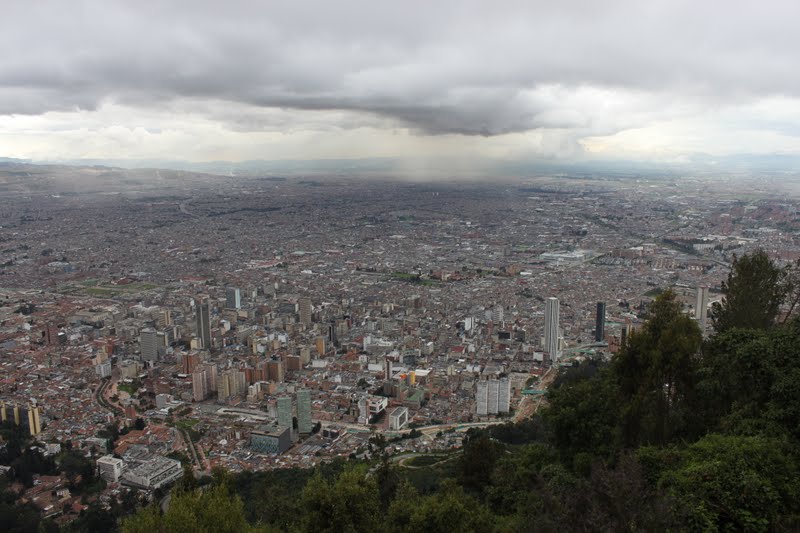
The next morning, I woke up to the beats of my blackberry alarm as I wanted to make the most out of my first full day in Bogota. Contrary to the advice Maria Andrea had given me (hehehe), I decided to walk all the way down to the centre, where most museums and other recommendations on my “to do” list are located. It took me nearly 2 hours to walk the c. 70 blocks between 85th street (Maria’s place) and the downtown area of La Candelaria. Closeby, at Los Andes University, I meat Maria for lunch (following a cool tour of the university, which is right on the Andes mountain side – hence the name. The buildings are intertwined within dense vegetation and progressively climb up the hillside – truly impressive. All that toppled with “invasions”, or illegal housing settlements, here and there). I took in an impressive view of the Andes while having a Calentado (https://blogger.googleusercontent.com/img/b/R29vZ2xl/AVvXsEjjBv3Kfh0OKX9_F4kXq0AE3RzGnAXqIJc-yutKTgzxm2QPmne2VV1U2MVJkYGUikwOatnSVFEZrojL5kRfznoz3-JG36lyDqIhdOJ6cxHckIm3NGFIk08xmeXUR5fMtOxLupK_Hy-mrUk/s1600/DSCN2845.JPG) and set out to do some sight-seeing. First stop, I went up (on a funicular) to Monserrate, a church in the “cerro”, or mountain, right in the centre of Bogota. Some amazing pics later (some below) and after wandering about the monastery (I think it was a monastery?), I returned downtown and explored the city centre some more. After plaza Bolivar, where the main cathedral and the Palace of Justice are located, I went to Museo Botero, where I could see first-hand some of the most amazing pieces of art from the Medellin-born figurative artist Fernando Botero. In it, one can find not only some of his most impressive works, but also his private collection (Picassos, Bacons and Ernsts included), which he donated to the Colombian Ministry of Culture. It must have been c. 7pm by the time I left the museum and without any time to hit up any other “cultural venues” that day, I walked back to Maria’s – another c. 2 hour walk. Consolation (or actually motivation) is that it was serving as preparation for the Inca Trek I am about to begin (I am in Cusco, Peru now – just arrived). Dinner was light but very well prepared by Maria and better accompanied by a Club Colombia (a fantastic nationally-brewed beer). Early night in order to rest up ahead of the day trip I had in sight for the next day.

After a c. 5:30am wake-up (yes, even though I am on holidays sometimes I do need to wake up early... very early!) I took a bus to the northern train station (Portal Norte). There, I was due to catch a suburban bus to Villa de Leyva, a beautiful little colonial town about 3 hours north of Bogota and which has remained almost intact as it once was during Hispanic times (16th-18th centuries). There, I explored the little town, went around its endless monasteries, learnt about Antonio Nariño (who contrary to popular belief is considered the true and most important political and social figure in Colombian contemporary history and libertador, above Simon Bolivar - http://en.wikipedia.org/wiki/Antonio_Nari%C3%B1o) and had lunch in a local eatery for 7000 pesos (c. EUR 2). A few hours later, I took the bus back to Bogota as I was due to meet Maria and Rafa for dinner. Not sure I mentioned this already but it had recently rained heavily in the region, and across Colombia as a whole. So, the regional and small roads winding around the Andes were very much subject landslides. So you guessed it... about an hour into the bus ride back to Bogota, the bus suddenly stopped. Much to our surprise, we were informed that it would be a while before we could get moving, no further details provided by the bus driver – out of curiosity, I stepped out of the bus and walked up the road to see what the big hold up was. Turns out there had been a landslide ahead of us a few hours earlier and the road was blocked by rocks and mud. Can’t miss pics below... The Colombian rescue team even used explosives to clear the debris on the road. Everyday winter thing for Colombians... once in a lifetime thing for your narrator. The delay “only” amounted to c. 1 hour and managed to make it in time for the dinner we had planned at Club Colombia (preceded by an improvised jammin’ session at Maria’s with a few friends of hers), a traditional restaurant set in a very well-maintained colonial house in downtown Bogota. We had some local delicatessen such as (can’t remember it all guys... sorry!) Ajiaco, Yuca frita, Arepa de Huevo and so on. Really amazing stuff! Could have never guessed Colombian cuisine would be so succulent. Thumbs up!

The next morning, I woke up early again and went to the National Museum – a cool and pretty big place where one can navigate through the various stages of Colombian history, everything from prehistoric times to contemporary liberal movements and the constitution of 1991. Thrilling place where I spent almost 4 hours. After a quick lunch at a nearby restaurant Maria had recommended I headed back home to pack. Had to catch a plane to Lima (this time direct!) in the evening.2.5 hour flight, arrival in Lima at 12am and 6-hour layover before catching a flight to Cusco. During that thrilling 6 hour wait I began drafting this post, and here I am wrapping it up at the hostel in Cusco. Next up Inca trail, but that calls for another tale – likely to hit ad infinitum in a few days. For the time being, here are some pics for you all to enjoy.

Peace.

pv


Thursday, 21 April 2011

benemerito de las americas.

This unusual yet incredibly-cited and used expression in Mexico may be unknown to many, if not most, of the readers of this post. Although the name may not necessarily refer to what/who I am about to share with you, as, for example, the town in Chiapas - Southern Mexico -, while spending time anywhere in Mexico it tends to only be associated to one person: Benito Juarez, who was a former Mexican president (19th century), lawyer and one of the country's most famous politicians. Before getting into his story and why he seems to be so relevant in Mexico, let me tell you that here thousands of places, areas, buildings, etc. are named after him, to name a few: Aeropuerto Internacional Benito Juarez (Mexico D.F.), Hemiciclo a Juarez (Monument in downtown DF), Oaxaca de Juarez (Oaxaca, city in which he was born) as well as the many streets, parks and other public buildings across the country. He is also depicted on the 20 peso bill (c. USD 2). He is most notably remembered for having lived and played an active political role during one of contemporary Mexico's most important periods, known as "La Reforma" and which came directly after the Guerra de Independencia against Spain (1810-1821). Aside from being a firm promoter a the division of power between the State and the Church (Leyes de Reforma), and the first Mexican president of indigenous descent, he devoted most of his political life to fighting against foreign-imposed governments and occupation. He fought incessantly against the French army and the French-backed Emperor, Maximilian I of Mexico. Due, in general terms, to this political legacy, and, in particular, to his dedicated fight for and defence of the freedom of the Mexican people and state, he was proclaimed Benemerito de las Americas, a title recognising him as one of the most relevant political statesmen in contemporary American history.

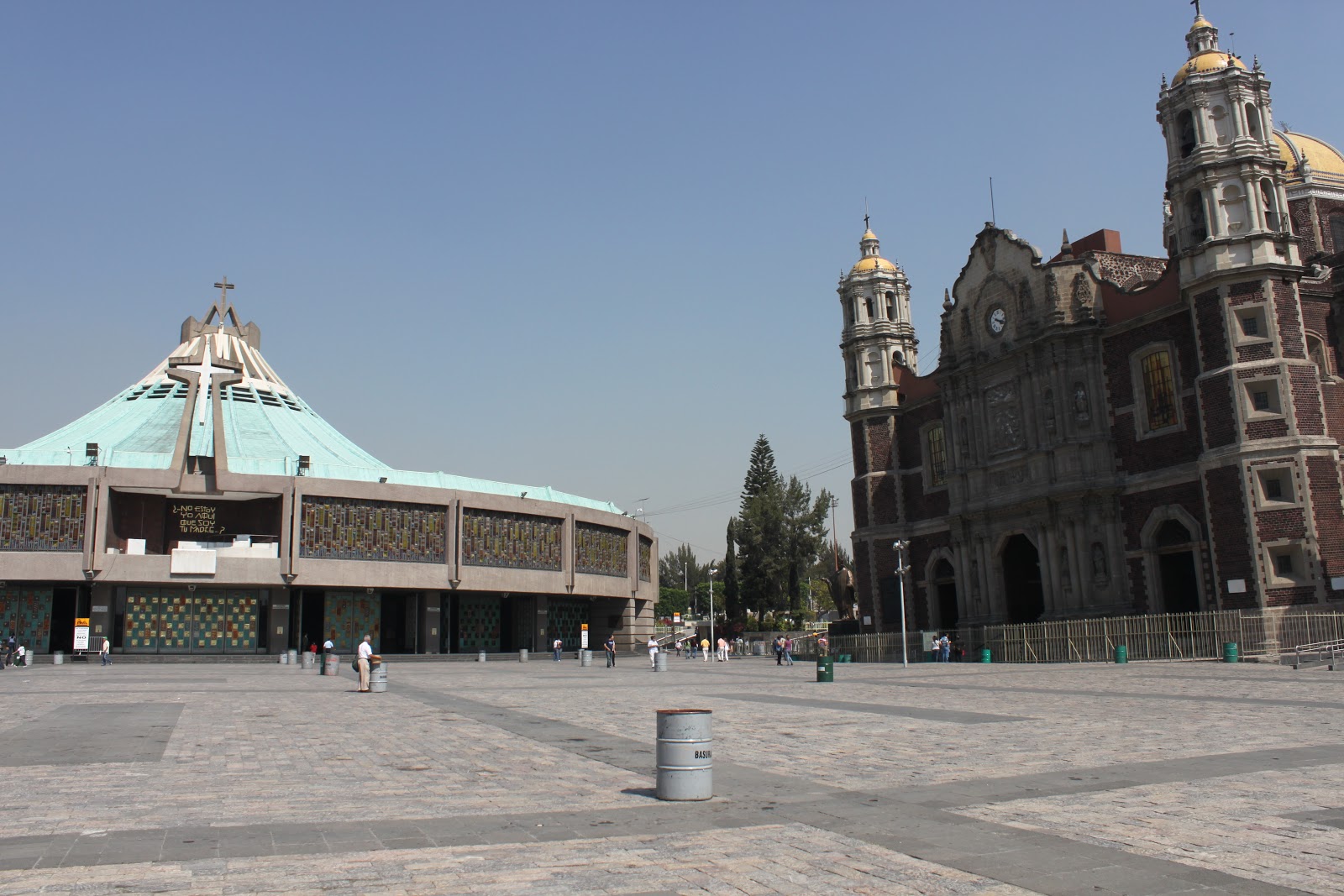
... And so my round-the-world (from now on rtw or RTW) adventures began in Mexico. After a c. 12 hour flight from Madrid, I landed in Mexico D.F. (from now on DF) last Wednesday (13th April) at c. 6pm local time. After getting my bag and getting some local pesos, I took the metro/tube (called here Sistema de Transporte Colectivo) to downtown DF where my hostel (Hostel Amigo, yes... that was actually the name of the place!) was. Although the airport is somewhat close to city centre, it must have taken me close to 1 hour to get to my destination... that just gives all of you a glimpse of the magnitude of this city (c. 20 million live in the city and its surrounding municipalities). After getting to the hostel and settling in, I met a very friendly Austrian guy who had spent the last 4 months backpacking around South and Central America. We were both pretty done but still decided to go out to a lively area close to our hostel to have a few drinks. The next day we both went on a hostel-organised tour to the close-by ruins of Teotihuacan (for those of you also on Facebook, the latest profile picture I uploaded was taken there!) - http://en.wikipedia.org/wiki/Teotihuacan - which is one of the most famous archaeological sites in Mexico and Latin America and which mainly consists of a truly exceptional pre-hispanic pyramid complex. On the tour, which latest most of the day, we also went to a local mezcal/tequila production and artisan site situated close to Teotihuacan as well as to the Basilica de Guadalupe and the downtown Aztec ruins of Tlatelolco. After an exhausting first full day in DF, it was a pleasing surprise to see that the hostel was hosting a "beach party". Even though I was dead tired after a full day of site seeing... what the heck! and the festivities lasted well into the night. Special mention goes out to my buddy the Mexican street performer, Jorge, with whom I chatted extensively and who played some of the best versions of Pink Floyd I have ever heard! ;)

Day 2 started early with a planned visit around some of DF's largest and most famous markets. 4 hours later and after having extensively covered some of the most fascinating intertwined mixes of culinary, religious, textile and, in general miscellaneous produce, my Austrian buddy and I stopped for lunch and a breather at a local restaurant where we had a succulent 3-course "Ejecutivo" meal for under 40 pesos (c. USD 4). After, we walked around the city and visited the Palacio Nacional Museum, the Cathedral (both of which are right on the Zocalo - or main square) and the Palacio de Bellas Artes. Later that day, I returned to the hostel and decided to go out with some Aussies, Swedes and a Hong Kong-er (is that how it's meant to be said?) to a wrestling match/fight/combat. Although I am not a huge fan (to say the least...) of such a "sport", I though it would be interesting to check it out, particularly in order to compare and contrast versus what's typically shown on TV in Spain and in the US. We got general entry tickets for c. 35 pesos (I think I can refrain from doing the fx conversion as by now all of you should have picked up the USD, EUR, GBP, etc. equivalence. hehe) and, to be honest, were not really aware of what we were in for... The "event" lasted almost 3 hours so it was a bit much. Nevertheless, what was reassuring was that I paid less for a ticket than for a large (c. 600ml) beer inside the arena. That's always good news! :) It was still truly intriguing to find how many people packed the arena (capacity: c. 15,000-20,000) and how much people were into the "show", although it was blatantly clear all the punches, kicks and jumps were fake. Also, one could see entire families attending the event, small children included. Not my cultural cup of tea but cheers to local tradition (I guess?). After getting back to the hostel, a couple of Uruguayans, two Aussies and myself set out to discover the world-famous nightlife in Colonia Condesa (which is meant to be the most "branché" part of town and where many artists and musicians live). Not disappointing!
After an early-morning (or at least as much as I could given the outing of the previous night) wake-up and after having sketched out my preliminary route around Mexico, which was meant to take me to the South and on the Pacific Coast, I headed to TAPO bus station (Terminal de Autobuses de Pasajeros de Oriente) to catch a bus to Puebla (or Historica Puebla de Zaragoza, which is one of its many official names), which is located about two hours South East of DF and is famous for the Battle of Puebla of 5th May 1862 (http://en.wikipedia.org/wiki/Battle_of_Puebla) in which the Mexican army were victorious against the French. After arriving in Puebla, I had to bear with a c. 1.5 hour walk from the bus station to my hostel (Hostal Santo Domingo). I did get to city centre just in time for the Semana Santa festivities and witnessed some really cool fireworks and street performances along Avenida 5 de Mayo right by the Zocalo area. I ended up calling it a night after a quick bite close to the hostel and left most of the site seeing and wandering around for the following day.

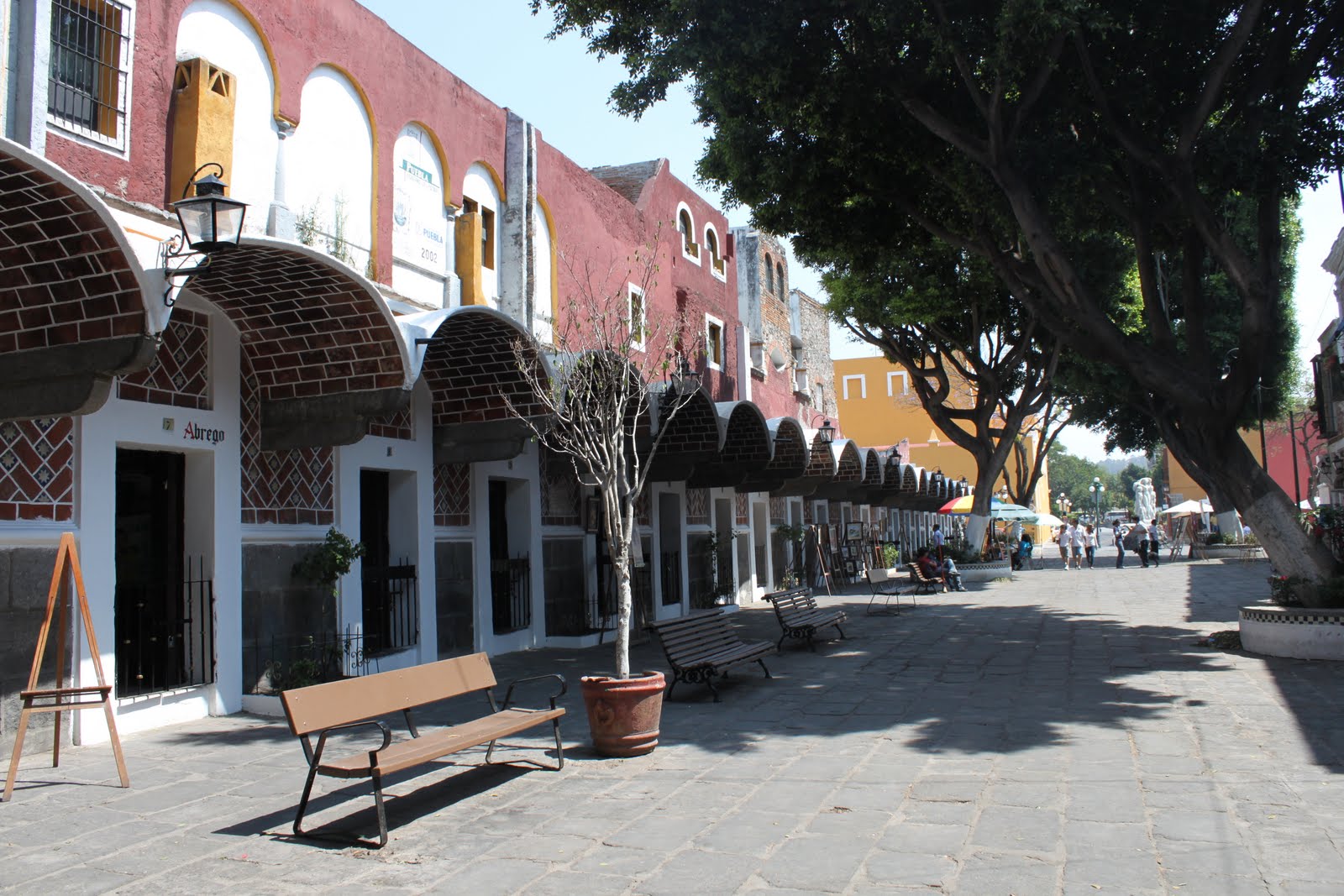
The following day, I visited most of Puebla (although, as I would later find out from a local I would meet in Oaxaca, I missed out the "must-see" / "must-enjoy-the-nightlife" area of Cholula) in just under 4 hours. The city is well-know, aside from its historical relevance as pointed out above, for the beautiful architecture, the great local cuisine and the hundreds of churches one can find in the city. During my visit to the city I even sat in for a few minutes to a "Domingo de Ramos" (relevant Semana Santa day for Roman Catholics) service in the Cathedral which, interestingly enough, was being translated into sign language as the priest and his gang were speaking/singing. Never seen that before! After lunch I went to CAPU (Central de Autobuses de Puebla), this time in c. 45 minutes as I took some shortcuts, and got on a bus to Oaxaca. The bus ride took about 4 hours and I got to the hostel (Casa Angel) at c. 9pm. After getting settled in my dorm, I went upstairs to the rooftop terrace where the hostel staff was hosting a BBQ. There I met a Pueblan (to whom I was referring above) and a Honduran, with whom I would end up hitting some of the local spots that night.

The next morning, the three of us took a bus to Monte Alban to spend a few hours visiting this smaller-than-Teotihuacan but yet as impressive archaeological site. I pulled off the "I am a student" card (not sure I told you, but before leaving Madrid I got my hands on a International Student Card which is getting me tonnes of discounts so far!) and got in for free (vs. 51 pesos general entry). Truly fascinating site (picture below) but it was extremely hot so we ended up "only" staying c. 3 hours. In the afternoon, and after lunch at a "Torta" (Mexican sandwich) place, I set out to visit downtown Oaxaca on my own as the guys I was with had already done so the previous day (they got into the city a day before me). General impression was that it was a much more touristy city, particularly non-Mexicans. The zocalo area was packed with "Plaza Mayor" (Madrid, Spain) style restaurants for tourists and you could hear a lot more other language than just Spanish. The city is beautiful though and a lot of the city centre is pedestrian only, which was a pleasant surprise! I particularly liked the Santo Domingo de Guzman church which has an entrance preceded by a huge square where street vendors and food carts are based. I actually had dinner at one of these local food carts with my buddies from the hostel. We were all catching a night bus (at c. 11pm) to the Southern coast (they were going to Puerto Escondido and I was going to Zipolite - via San Pedro de Pochutla) so decided to have a traditional Mexican dish - a Tlayuda - (http://oaxacaculture.files.wordpress.com/2008/06/tlayuda-con-tesajo.jpg) before heading out to the station. It was a delicious torlilla filled with avocado, tomato, lettuce, frijoles and cheese, topped with chicken or "carne de res" (beef) - I had the latter. After we parted ways at the station I boarded my 7 hour bus to Pochutla.

I got to Pochutla very early in the morning, at c. 7am, and took a "Colectivo" (c. 20 person "bus" used for local transportation which consists of a metal cabin set atop an SUV trunk) for c. 10 pesos. The journey to Zipolite took c. 1 hour as I had to change colectivo (according to a local I spoke to/got directions from, the local colectivo groups have been fighting for a while and as a sign of protest, the Pochutla-Zipolite route is no longer direct). I got to Zipolite at c. 8am and my first impression was that of one of the most beautiful places (let alone beaches) I had seen in my entire life. Set right on the Pacific Coast, the Zipolite coastline is about 2km long and, according to some, is one of the most dangerous beaches in the world (someone I met there claimed that in the last few years, on average, 1 person has drowned there every month). It is also a marvellous beach where mostly locals go and which is also famous for having historically been a popular hippy hang-out spot. After a walk along the beach early in the morning and after declining to accept a room for 400 pesos a night at a spot that one of my friends from home had recommended, I settled in a nearby hostel consisting of wooden shacks/compartimentos right on the beach and with a great bar and stunning views (Hostal Brisa Marina). I took a c. 3-hour nap (I was unfortunately unable to catch much sleep on the bus down to Pochutla) and then met a group of backpackers at the hostel bar (two Canadians, one my dad's age - lol -, two Italians, one welsh-man and three Swedes). Our afternoon and evening activity mainly consisted of enjoying the Pacific breeze/view and talking about our preceding/following travel plans at the bar. In between a chat and a beer here and there I also went in for a swim (swimming in the Pacific Ocean... check!), although not very far in as the see was quite rough and the red flag must have been on display across the coast for a reason. We then enjoyed a dinner at a local food shack by the beach and partied on the beach by a few bonfire-lit music scenes well into the night.

The next morning (this was yesterday!) I woke up late and was taken back to Pochutla by one of my Italian buddies by car (which he had borrowed from a local store clerk he had met a few days earlier) - he also needed to get into town to go to a cashpoint. In Pochutla I got a ticket back to DF on a bus which wasn't departing for a couple of hours. Given the time difference, I was hoping to spend that time watching the Real Madrid-Barca game at a local bar. After much hassle in trying to find it I finally did... "La Iguana Rajada", where I enjoyed the game with c. 100 locals which. I would say were c. 50:50 split between Barca and Real Madrid. Tragic night in the end for the Barca crowd in the bar, but definitely cool to enjoy the game and the magic of football with locals. The bus 17-hour bus back to DF left at c. 6pm and the journey was relatively uneventful. I was seated, though, next to an Australian girl who had been travelling across Mexico for the past 2 months with her surfboard. She had just spent 2 weeks in Puerto Escondido and was going back to DF to catch a plane the next morning to Baja California. We had a lengthy conversation on just about anything but both ended up passing out at c. 11pm. Arrival into TAPO at 11am and after a 3 hour tour of Colonia Condesa (this time by day! hehe) and while I wait to head to the Airport for my Mexico-Lima flight later today, I walked into a "wifi-enabled" bar to share my first thoughts of my rtw trip with y'all.

Next up Peru and Colombia... if you found the above a little bit interesting, let's hope my coming adventures don't disappoint you. I'll try my best. As has become a tradition, I will leave you with a few snapshots of Mexico.

Hasta pronto!

pv


Wednesday, 13 April 2011

so this is it.

Hi everyone,

I guess those of you following me via facebook have figured by now what this post is about due to my posting, a few days ago, of  the first leg of my itinerary. For those of you who are still in the dark, I am shortly due to board a flight to Mexico City which will, officially, represent the beginning of my 4 month round-the-world trip. Now that we are all on the same page, let me tell you that it is hard to describe how one feels. Well, generally speaking, there is an evident feeling of excitement and, essentially, a feeling that I am facing the opportunity of a lifetime. As most of you know, I have had the great chance / privilege of travelling somewhat during my youth and early adulthood. On most occasions, particularly as a kid, this travel habit was more out of necessity than self-imposed. This early and continued exposure to foreign countries and cultures nurtured a truly genuine interest in exploring those environments beyond the boarders of my country of origin or, as a matter of fact, of residence. At times, this passion has been somewhat contained by third parties, such as the time I spent in London - where, due to my professional responsibilities, I was unable to travel as much as I would have wanted to. Nevertheless, now that this stage has been left behind and while I await to begin my MBA in Chicago in September, I now have just over 4 months to explore and discover the world round. My Feb-Mar Balkan/CEE "escapade" was, in fact, a preparation for the bigger course, and intro to the real deal. And so, here we are... this is it.

In these four months I will set foot in most continents and discover, in most cases for the first time, truly unique and extremely appealing countries. After Mexico, I will head to to South America, where I will tour Peru, Colombia, Brasil and Chile. Following a 20-hour Pacific pond jump, and a c. 2-week stay in Australia, I will arrive to Japan. Then, China, Hong Kong and a number of South East Asian countries (Thailand, Cambodia, Laos, Vietnam, etc.). Finally, the last leg of the trip will consist of India, Jordan and Turkey. Back to Madrid in mid August, in the midst of the summer holidays, where most will have fled to "cooler" areas pursuing the sun, the beach and the chaos of Spanish coastal areas (not only from a real estate perspective, but also because these areas - such as Marbella, Costa Brava, etc. get absolutely packed with people during the month of August. In animal behaviour terms, not that I am any expert in the field, one could compare it to cockroaches fleeing from insecticide-filled urban areas).

As I did during my trip across Eastern Europe, I am hoping to keep this blog up as my main means of communication with my (I am hoping vast! hehe) community of followers. I will aim to publish 1/2 posts per country, depending on the internet connectivity I am able to find... You never know. In any case, "Ad Infinitum" will start becoming more frequent than during this "time-off" period I have just spent in Madrid.

Safe travels to all of you... and let's keep in touch.

pv  

Monday, 28 March 2011

the angriest black man in america.

Due to my current temporary and compulsory "no-travel" status, I am unable to thrill the audience with anything related to my adventures on the road. Notwithstanding, I am pleased to be able to share with you an extract from the latest literature I have put my hands and brain on to. If there is something that a "soi-disant" inactive individual (don't take this the wrong way... I do refer to my status as "not working and not actively seeking a job". For those economists in the group this will be easy... Think of it as: Population = Active + Inactive; Active = Employed + Unemployed. Therefore, my self-imposed and self-proclaimed title ranks me along the retired folk - except without the social benefits! -, the stay-at-home-moms and the like) has... that's time. Now that I have rediscovered this precious and scarce "resource" after an oblivious 2.5 years, I spend a considerable amount of my "non-travelling" time, well... reading.

The latest delicacy I have been able to intellectually devour has been Malcom X's autobiography. I think I may have commented on this choice of literature in an earlier post. Many people tend to vaguely associate Malcom Little (or El-Hajj Malik El-Shabazz, as he would later be known) with the 1950's and 1960's Civil Rights Movement in the US and with the struggle of the African-American population in their desperate quest for civil and racial equality. He is also known for having been Dr. Martin Luther King Jr.'s contemporary and for having shared with the latter's ideology nothing but a necessary "social" movement of the African-American population in the US. Their ideologies were very distinguished in their vision, their religious inspiration, their methods and the extent to which they believed that a social advancement of the African-American population had to be irrevocably accompanied by a full demise of the White population. As is pointed out in the title line, Malcolm X began to be referred by some as the "angriest black man in America", at the hype of his career in the early 1960's as a muslim minister, public speaker and political agitator due to his preachings of racism, black supremacy and violence. As can clearly be inferred in the text he wrote, with the assistance of Alex Haley, as a reflection upon his life and works, the many troublesome experiences he endured in his childhood, adolescence and early adulthood, which would eventually turn him into a convict, had a significant impact on his development as one of the most relevant and influential African-American individuals in history. Most importantly, the time he spent in prison (7 years, between 1946 and 1952) turned him to the Muslim Faith, more specifically to a movement called "The Nation of Islam". Although I was somewhat familiar with the movement before reading the book, its foundations and its driving principles, the passage in which Malcom X describes his interpretation of the movement's philosophical being and how it was taught to him proved absolutely fascinating. Thus my desire to share it with all of you. Apologies for the extension of the extract, which I will split in two posts so you can take a breather. This first part covers the overarching theme of white anthropological supremacy while the second post will cover the more "mystical" nature of the black man's evolution and how it was taught by The Nation of Islam to its devoted followers. By the way, kudos to Penguin Books for allowing my copy-paste, I am sure they don't mind. If your mom or dad does work in publishing, please don't tell them! hehe. ;)

pv


     "... And what they termed 'the true knowledge of the black man' that was possessed by the followers of The Honourable Elijah Muhammad was given shape for me in their lengthy letters, sometimes containing printed literature.


      'The true knowledge', reconstructed much more briefly than I received it, was that history had been 'whitened' in the white man's history books, and that the black man had been 'brainwashed for hundreds of years'. Original Man was black, in the continent called Africa where the human race had emerged on the planet Earth.
      The black man, original man, built great empires and civilizations and cultures while the white man was still living on all fours in caves, 'The devil white man', down through history, out of his devilish nature, had pillaged, murdered, raped, and exploited every race of man not white.
      Human history's greatest crime was the traffic in black flesh when the devil white man went into Africa and merdered and kidnapped to bring to the West in chains, in slave ships, millions of black men, women and children, who were worked and beaten and tortured as slaves.
      The Devil white man cut these black people off from all knowledge of their own kind, and cut them off from any knowledge of their own language, religion, and past culture, until the black man in America was the earth's only race of people who had absolutely no knowledge of his true identity.
      In one generation, the black slave women in America had been raped by the slavemaster white man until there had begun to emerge a homemade, handmade, brainwashed race that was no longer even its true colour, that no longer even knew its true family names. The slavemaster forced his family family name upon this rape-mixed race, which the slavemaster began to call 'the Negro'.
      This 'Negro' was taught of his native Africa that it was peopled by heathen, black savages, swinging like monkeys from trees. This 'Negro' accepted this along with every other teaching of the slavemaster that was designed to make him accept and obey and worship the white man.
      And where the religion of every other people on earth taught its believers of a God with whom they could identify, a God who at least looked like one of their own kind, the slavemaster injected his Christian religion into this 'Negro'. This 'Negro' was taught to worship an alien God having the same blond hair, pale skin and blue eyes as the slavemaster.
      This religion taught the 'Negro' that black was a curse. It taught him to hate everything black, including himself. It taught him that everything white was good, to be admired, respected and loved. It brainwashed this 'Negro' to think he was superior if his complexion showed more of the white pollution of the slavemaster. This white man's Christian religion further deceived and brainwashed this 'Negro' to always turn the other cheek, and grin, and scrape, and bow, and be humble, and to sing, and to pray and to take whatever was dished out by the devilish white man; and to look for his pie in the sky, and for his heaven in the hereafter, while right here on earth the slavemaster white man enjoyed his heaven."

Passage from Chapter 10, Satan, of The Autobiography of Malcolm X, with the assistance of Alex Haley, Penguin Books


Wednesday, 23 March 2011

18 January 1943.

Although the date above could very well mark many historic events, particularly - as one can surely imagine - in the context of WWII such as: the uprising of the Soviet forces in Leningrad against the Nazi and Finnish imposed siege, the sporadic and rather uncoordinated bombing of London by the Luftwaffe and (relevant in today's geo-political climate) five days prior to the Allies' liberation of Tripoli (Libya), in most History books it will stand out for being the date in which the Warsaw Ghetto uprising began. Although only lasting 4 months and after being crushed with utter violence by the Nazi occupation forces in Warsaw, this event did spark a common feeling or goal amongst the inhabitants of Warsaw - and even, to some extent, of broader Poland - which was none other than fighting, no matter the cost, for liberation. The Warsaw Ghetto was built in the period 1939-1940, shortly after the Nazi invasion of Poland and was aimed to house the c. 400,000 Jews living in the city. Although it was meant to hold nearly 30% of Warsaw's population, it only covered c. 3% of the size of the city. The ghetto was ultimately closed out to the world in late 1940, when the Nazis built a wall, deployed barbed wire fences and established armed guards. As time went by, the Nazis progressively shrunk the size of the ghetto, living conditions worsened, diseases began to spread and the inhabitants began to perish, either of starvation or, on many occasions, as a result of Nazi oppression. The revolt marked a "natural" reaction against such dreadful living conditions and the unlawful German occupation. In spite of a well-timed and intelligently-articulated uprising, the poorly-armed ghetto inhabitants were rapidly crushed by the Nazi forces. Today, little remains of the Warsaw Ghetto as, similarly to what happened to most of Warsaw, it was blown to pieces - at times, deliberately and building by building - by the Nazis before they fled and the Soviet forces liberated the city in 1945. Although unsuccessful, the uprising did at least help the Jewish, as well as broader Polish, population unite against the Nazis. A year after the ghetto uprising, in 1944, the city of Warsaw witnessed yet another uprising, although on this occasion it involved the entire city and lasted almost until the end of the war. One could thus argue that the Warsaw Ghetto uprising was one of the key catalysts that led to the emergence of a sovereign liberation movement in Poland and to a weakening (or at least defiance) of the framework principles of the Nazi occupation.    

By the way, for an interesting yet suspiciously-documented and rather poorly-developed timeline of WWII don't hesitate to check out the following link: http://www.spartacus.schoolnet.co.uk/2WWchron.htm

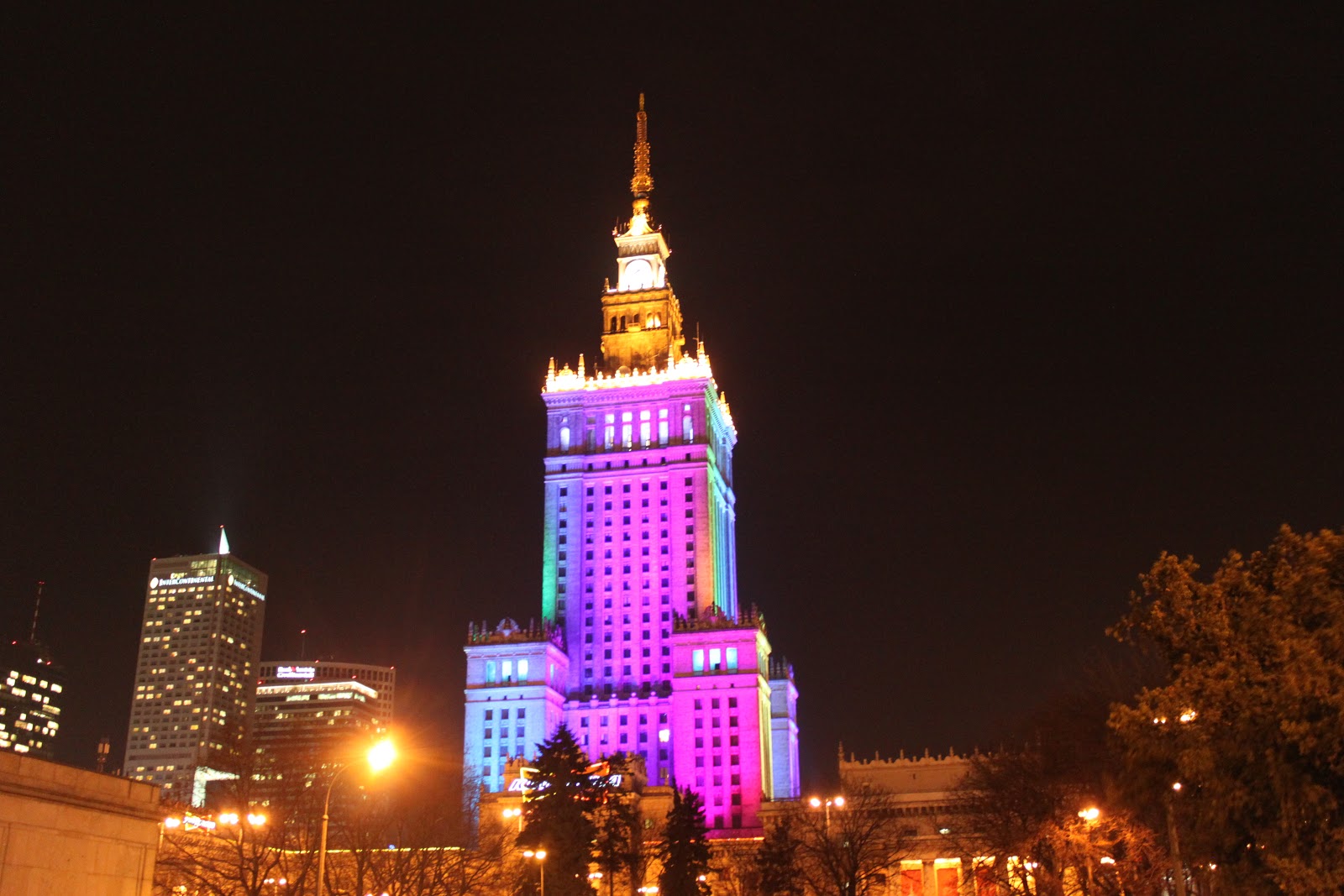
After a short (in relative terms compared to some of the other journeys I have had to endure during my trip) 3-hour train ride from Krakow, I arrived to Warsaw at c. 8pm. Upon beginning my walk from the train station to the hostel, I was very impressed by the modern appearance of the city. As I stepped out of Warsaw Centralna, I found myself surrounded by a bunch of "skyscrapers" (granted they weren't that tall, but at least a good 30 stories!). That was to my right... because to my left I saw the soviet-looking (no wonder, as it was a "present" from Stalin to the city of Warsaw in the early 1950's) Palace of Culture and Science, which was all lit up in an "Empire State Building"-ish fashion (http://www.warsaw-life.com/poland/palace-of-culture-and-science). Some people mention that the building, which resembles the 7 sisters in Moscow (http://www.moscow-life.com/moscow/seven-sisters) was nearly taken down in 1989, when the Berlin Wall fell. I must admit that my evening that day was rather uneventful... it must have been before 11pm when I called it a day. Before passing out, though, I did manage to post (I think on Bratislava) and to get all the tips on the city from the very helpful hostel staff. They even had a 3-pager (investment banking term for a document/memo one thinks will take 1 hour to prepare... but, in fact, ends up taking an entire day. Respect!) they were handing out with recommendations for the weekend (Friday-Sunday). On Saturday, I woke up pretty early (c. 8am) and after a fresh pastry + coffee at a nearby cafe, I headed West, towards the Warsaw Uprising Museum (N.B. do not confuse with the ghetto uprising of 1943. The city-wide uprising took place in 1944, on the verge of the Nazi surrender, and was by far more disruptive. It was nevertheless, as I point out above, somewhat "inspired" by the ghetto uprising of 1943). Interesting museum, although slightly difficult to follow the permanent exhibition as some rooms seemed to totally lack cohesive and chronological order. Nonetheless, the 3D movie the museum was showing for an additional 2 zlotys (0.5 eur) was definitely a must. Essentially, it is a digital reconstruction of a "reperage" flight above Warsaw at the end of WWII, which clearly shows the total annihilation of the city. In case there are any stats-savvy ones in the audience, for your reference: In 1939, 1,100,000 people lived in Warsaw. By January 1945, only 1,000 lived amongst the city ruins and nearly 85% of the buildings and infrastructure had been blown to pieces. Here's the link to the c. 6-minute-long clip: http://www.youtube.com/watch?v=Cxb5H77wYt0&feature=fvwrel

After spending most of the morning in the museum, I began to wander around the city. Amazingly enough, Warsaw is a city that was entirely rebuilt in the 1950's and 1960's. Very little (cfr. stats above) remains of the pre WWII city. There are very few spots with original buildings. One of these, actually from the Warsaw Ghetto, can be found on Zlota street (some pics below). Aside from very few remnants, most of the city centre was completely rebuilt. Interestingly enough, the street my hostel was on, Nowy Swiat, stands for New World (http://www.warsaw-life.com/poland/new-world). I also crossed the Wisla river to the other side of town (called Prague - yes, like the city in the Czech Republic), where there is not so much to do, but is still quite interesting as most of that part of the city remained intact during WWII (surprisingly enough, as from 1944, Soviet troops were based there - they still refrained from assisting the local population in the 1944 uprising!). Prague is also the part of town where the new Warsaw city football stadium is being built, in anticipation of the 2012 Football Eurocup (which Spain will surely win!). In the evening, and just prior to returning to the hostel, I also visited Park Lazienkowksi, which is a beautiful Retiro-style (http://www.aviewoncities.com/madrid/parquedelretiro.htm) 19th century park in the middle of the city. It must have been around 8pm when I finally got back to the hostel. As I was due to catch a flight back to Madrid the next morning at 10am, I was in need of an early night. Nonetheless, who would have thought, I met a very friendly + interesting Dutch bloke back at the hostel, with whom I agreed to go out for drinks. The next bit... all of you can surely imagine.

Next morning, 10am - LOT Airlines flight back to Madrid... Yes, that does mean the end of this trip... I hope you all enjoyed my adventures, stories and anecdotes around the Balkans and Central & Eastern Europe. I am hoping to hit the road, this time for a longer and even more fascinating trip, very very soon. So, while you check out the pics from Warsaw, try to stay tuned!

pv